
Annapurna Base Camp Trek Itinerary
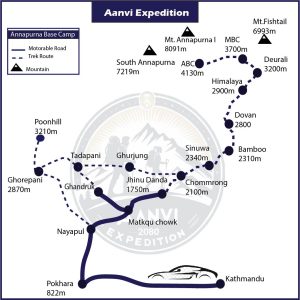
Day 1: Pokhara to Chomrong
Drive from Pokhara to Jhinu (3 hours). After a 30-minute walk, have lunch at Jhinu Danda. Continue walking from Jhinu Danda to Chomrong (2 hours). Chomrong village offers stunning views of Annapurna South and Hiunchuli. Experience the rich culture of the Gurung people and their warm hospitality. Stay overnight at Chomrong village.
Day 2: Chomrong to Himalaya
Wake up at 6:30 AM for breakfast and start walking towards Himalaya. The trail involves crossing the Chomrong River and climbing uphill through forests. After a 3-hour hike, have lunch at Bamboo or Upper Dovan. Post-lunch, continue walking for another 2-3 hours to reach Himalaya. Along the way, enjoy the lush bamboo and rhododendron forests. Stay overnight at Himalaya.
Day 3: Himalaya to MBC
Wake up at 7:30 AM, have breakfast at 8 AM, and start walking towards Machapuchare Base Camp (MBC). It takes 2 hours to reach Deurali, where you can take a tea break. From Deurali, it takes another 3 hours to reach MBC. The trail offers majestic views of the surrounding peaks, and you might spot some wildlife like langur monkeys. Have lunch and stay overnight at MBC.
Day 4: MBC to Annapurna Base Camp
Wake up at 6 AM to witness the golden hues of the mountains at sunrise. Have breakfast at 7 AM and then walk towards Annapurna Base Camp, which takes 2-3 hours. The trek to ABC offers panoramic views of Annapurna I, Annapurna South, Machapuchare, and other peaks. Experience the serene and spiritual atmosphere of the base camp, surrounded by towering mountains. Stay overnight at Annapurna Base Camp.
Day 5: Annapurna Base Camp to Bamboo
Prepare for a long day of walking, approximately 8 hours, to reach Bamboo. Retrace your steps through the beautiful landscapes, passing Deurali and Himalaya. Enjoy the peaceful surroundings and the dense forests. Stay overnight at Bamboo.
Day 6: Bamboo to Jhinu Danda
Walk from Bamboo to Jhinu Danda (5 hours). Enjoy a relaxing dip in the natural hot springs at Jhinu Danda, a perfect way to soothe your tired muscles. The hot springs are a popular spot for trekkers to unwind. Stay overnight at Jhinu Danda.
Day 7: Jhinu Danda to Pokhara
Drive from Jhinu Danda to Pokhara. Rest for the day in Pokhara, reflecting on the incredible journey and the cultural experiences along the way. Explore the lakeside area of Pokhara, known for its vibrant atmosphere and beautiful scenery. Stay overnight in Pokhara.
Why to choose us??
- 4E (Experience, Expert, Elegant and Encouraging) guide.
- Flexible timing
- We modify our treks to fit your interests, providing flexible scheduling, individualized assistance, and bespoke itineraries all along the way.
- We are dedicated to encouraging sustainable tourism, honoring regional traditions, reducing our environmental impact, and practicing responsible tourism.
- unforgettable memories, from starting the journey to witnessing breathtaking landscapes.
- experienced guides who are well-versed with the terrain, ensuring a safe and enjoyable trekking experience
- Certain percentage of the fund will go to donation.
Note: You can choose a guide service or porter service only. Trek itinerary can be fully customized according to your time and convenience.
The cost of a guide or porter for the Mardi Himal Trek is US$30 per day for a guide and US$25 per day for a porter.
Note: Your guide is unable to assist you with your heavy luggage as they are only to assist you during the trek. Furthermore, the porter is only allowed to carry a maximum of 20 kg of luggage; if the bag weighs more, there may be additional charge.
Please note that the prices listed above are changeable; the actual cost will depend on your unique needs, transportation, activities and specially designed itineraries. We will be happy to provide you with customizable timetables that suit your preferences and needs. To discuss your plans or to ask any questions, send us an email at……………………….
What’s Included
- Transportation from Your Hotel to Trekking Ending Point and starting point in Pokhara by Cab or Jeep ( depending on group size )
- Accommodation during the trek
- Three standard meals (Breakfast, Lunch, and Dinner) during the trek
- Guides expenses – meals, insurance, salary, lodging, transportation, and equipment costs.
- Water purification tablets for safe drinking water
- All applicable Permits and TIMS
- Seasonal fresh fruits
- All government taxes, local taxes, and official expenses
- Licensed holder and experience trekking guide
- All Wages, Fees and Travel and Medical Insurance for Guide
- First Aid Kit
- Surprise after trek
What’s excluded
- Nepal Visa fees and International airfare
- Porter optional ($25 per day for 1 porter) where load limits will be 20 k.g.
- Extra hotel nights and activities during trek due to delays brought on by unforeseen or natural events like severe weather, landslides, and schedule changes brought on by illness, safety concerns, and so on.
- Your personal expenses as well as hotel and activities in Pokhara and Kathmandu
- Beverage drinks on the trek
- Travel insurance covering emergency high-altitude rescue for both medical expenses and helicopter rescue and evacuation from high altitudes.
- Travel insurance that pays Tips for guide and porter (it is appreciated)
- Finally, all of the fees and charges that aren’t included in the section under “What’s Included?”
How to get from Kathmandu to Pokhara?
There are a variety of transportation options Tourist vehicle / Private Car / Flight for Kathmandu – Pokhara – Kathmandu. If you choose one of them, we can arrange for you.
Things to remember
- Avoid leaving any trace
- Don’t pick flowers and damage flora
- Respect wildlife
- Don’t give anything to children. Though it sounds cruel, it helps to discourage begging culture.
- Watch your step and don’t walk blindly while taking pictures and photos
- Respect local culture and traditions
- Ask permission before taking pictures
- Don’t make loud noise while trekking
- Avoid drinking alcohol and smoking in high altitude
- Don’t rush and don’t push your limit in high altitude
Must carry
- Comfortable Trekking shoes
- Trekking poles
- 4-5 pair of socks
- 2-3 pair of Trek paints
- Trekking T-shirt
- Sweater
- Gloves
- Thermal set
- Wind and waterproof jacket
- Down jacket
- Raincoat
- Cap/sun hat
- Buffs /scarf and woolen cap
- Sun glass
- Sandals
- First aid kit
- Personal belongings
- Chocolates
- Sunscreen
- Head light
- Crampons (depends upon the season)
Note: If you have allergy to anything please pre-inform us
Mardi Himal Trek
| Trekking Name : | Mardi Himal Trek |
| Maximum Elevation : | 4500m, Mardi Himal Base Camp |
| Starting and ending point of trekking | kande/ kalimati |
| Trip duration : | 5 days |
| Trekking Difficulty : | Easy to Moderate |
| Best Time/Season : | Mar to May and Oct to Dec |
| Accommodation: | Tea-house, Lodge |
| Permits : | ACAP Permit and TIMS Permit |
| Group size | 1- 50 people |
| Special interest activities ( optional) |
Mardi himal trek
Mardi Himal trek is one of the fabulous treks which can be done within 4 to 5 days offering breathtaking views of nature and Himalayas, serene trails and sense of adventure away from crowded cities. Located at 4500m elevation, Mardi Himal trek is one of the easy treks located in Annapurna areas. The trail winds through rhododendron forests, quaint villages, providing a diverse and immersive trekking experience.
The Mardi Himal trek is a relatively shorter trek compared to other treks in the region which also offers the opportunities for exploration, adventure and photography. One can encounter the local cultures, local communities, Nepalese hospitality and one of the best views. However, if you have more than 5 days, We can combine the Mardi Himal Trek with another trek and look into side excursions using the same trekking permit. If you are planning to go for a Mardi Himal trek then you are at the right place where you can get a customized itinerary according to your will and preference.
Mardi Himal Trek – a perfect adventure for ALL
Major highlights
- Opportunities for capturing amazing pictures and moments
- Explore the hospitality, culture, and way of life in the area.
- Panoramic views of the Mardi Himal, Annapurna South, Hiunchuli, and Machhapuchhre (Fishtail) mountains.
- Several viewpoints offering breathtaking views of the Himalayas.
- Forest bursting with rhododendron blossoms especially from March to April in the spring.
- Hikers are rewarded with views of the surrounding peaks and glaciers at this area.
Best season to trek:
Spring (February to mid- May)
The Mardi Himal Trek experiences pleasant, mild springtime temperatures. During Spring, temperature is quite moderate and it may be cooler during night time. In higher altitudes, the weather is quite cooler than at lower altitudes. Lower altitudes usually see daytime temperatures between 15°C and 25°C (59°F and 77°F). Temperatures can fluctuate considerably at higher elevations, from 5°C to 15°C (41°F to 59°F). The Mardi Himal Trek is known for its incredible views in the spring. You can enjoy the forest covered in pink and red because of the Rhododendron. Rhododendron woods are in full bloom, bringing vivid hues to the surrounding area. Similarly you can enjoy the majestic view of the mountains like Annapurna, Mardi, Machhapuchhre, and Hiunchuli.
Compared to other seasons, springtime weather is often more consistent, which lowers the chance of experiencing unfavorable weather conditions like severe rain or snowfall.
Summer Season(June to August):
During the monsoon season, which runs from June to August in Nepal, summer trekking provides beautiful scenery and less traffic on well-traveled paths.. At lower elevations, expect warm, muggy weather, while higher altitudes will see colder temperatures. In order to prevent altitude sickness, safety measures include being aware of potential dangers such as landslides and leeches and making sure you’ve properly acclimated. Insect repellant, durable shoes, and waterproof clothing are necessities while packing. Trekkers can take advantage of Nepal’s summer trekking season’s breathtaking landscape and unique experiences by being prepared. If you want a less crowded trek destination, then this is the perfect time for you.
Autumn/fall (September to mid-December):
During fall, temperatures along the Mardi Himal Trek are normally pleasant and comfortable during the day, ranging from 10°C to 20°C (50°F to 68°F) at lower elevations. At higher elevations, temperatures can dip to roughly 0°C to 10°C (32°F to 50°F) during the day and can be colder at night. It’s best to pack layers so you can adapt to changing temperatures.
The Annapurna I (8,091m/ 26538 ft), Annapurna South (7,219 m / 23,680 ft), Machhapuchhre (6,997 meters / 22,950 ft), and Gangapurna Himal (7,454m / 24,450 ft) and of course Mardi Himal(5,587 m / 18,328 ft) mountains are best viewed in the autumn when the sky is brightest. Along the walking path, breathtaking views of snow-capped peaks and scenic landscapes are made possible by the clear, crisp air and weather.
Detail Itinerary
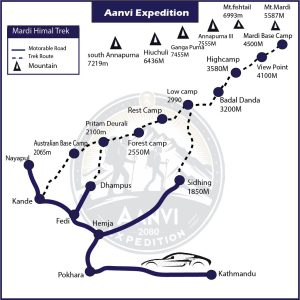
Day1: Pokhara to Pritam Deurali/lovely hill
Trekking Duration: 7 hours
| Altitude of Pokhara: 822 m | Altitude of Pritam Deurali/ 2100mLovely Hill: 2250 m | Altitude Gain: 1428m |
After breakfast, your guide will pick you up from your place of lodging and take you in a cab or jeep to the trek’s official starting location, which is either Fedi, Kande, or Dhampus village. Following that, you’ll go along hiking paths that pass through a village and a rainforest, where you’ll see a variety of plants and animals as well as people living their traditional lives. You will stay overnight at Pritam Deurali/lovely hill according to the convenience.
Day2:Pritam Deurali /Lovely hill to Low Camp
Trekking Duration: 5-6 hours
| Altitude of Pritam Deurali/ Lovely Hill: 2100m | Altitude of Low Camp: 2800m | Altitude Gain: 700m |
After breakfast at around 7 a.m you will start your trek to the low camp. You will walk through the traditional trails in the jungle where you can enjoy the flora and fauna. If it is the time of spring ( March to April) you can enjoy the Rhododendron where the forest will be decorated with the Rhododendron making it more beautiful.
You will have lunch at Rest camp and have a rest for a while. After around 4 hours of walking you will reach Low camp where you will stay overnight.
Day3:Low Camp to High Camp
Trekking Duration: 3-4 hours
| Altitude of Low Camp:2800m | Altitude of High Camp:3550 m | Altitude Gain: 750 m |
After breakfast at around 7 a.m you will start your trek. You will hike through the forest on the stairs and traditional trails. About 4/5 hrs walk you will reach the High Camp. You will have yourself time for the day as Day 4 is gonna be a long day And stay overnight at a high camp.
Day4:High Camp to Rest Camp
Trekking Duration: 5-6 hours
| Altitude of HighCamp3550m | Altitude of Rest Camp:2600m | Altitude loss: 950m |
Third day is one of the hard days where you would have to walk almost for 9-10 hours where you will wake up early in the morning at around 4:30 a.m and start a hike towards base camp or view point. You’ll find yourself amazed by the breathtaking views of glaciers and mountains blanketed in snow as you go on some higher parts and greenery.
You will enjoy the sunrise and picturesque view of the mountains like Annapurna South, Hiunchuli, Annapurna III, Machhapuchhre, and Gandarva Chuli from the viewpoints. After that you will return to have breakfast at highcamp and have some rest over there. After some rest you will trek towards the Rest Camp and stay overnight.
Day5: Rest Camp to Pokhara .
Trekking Duration: hours
| Altitude of Rest Camp: m | Altitude of Pokhara: m | Altitude loss: m |
Last day of the trek will start with the mesmerizing view of nature, and mountains. At around 7 a.m you will have breakfast and start your trek towards the beautiful village Kalimati from where you can experience the local culture and trace farming and many more. After the walk for a few hours you will reachKandefrom where a jeep or taxi will drop you to your hotel and end the trek
. 
Why to choose us??
- 4E (Experience, Expert, Elegant and Encouraging) guide.
- Flexible timing
- We modify our treks to fit your interests, providing flexible scheduling, individualized assistance, and bespoke itineraries all along the way.
- We are dedicated to encouraging sustainable tourism, honoring regional traditions, reducing our environmental impact, and practicing responsible tourism.
- unforgettable memories, from starting the journey to witnessing breathtaking landscapes.
- experienced guides who are well-versed with the terrain, ensuring a safe and enjoyable trekking experience
- Certain percentage of the fund will go to donation.
- Note: This trek itinerary can be fully customized according to your time and convenience.
Price estimation for Mardi Himal trek us
The price of the trek depends on the various factors like length of stay, activities done, and many more.
What’s Included
- Transportation from Your Hotel to Trekking Ending Point and starting point in Pokhara by Cab or Jeep ( depending on group size )
- Accommodation during the trek
- Three standard meals (Breakfast, Lunch, and Dinner) during the trek
- Guides expenses – meals, insurance, salary, lodging, transportation, and equipment costs.
- Water purification tablets for safe drinking water
- All applicable Permits and TIMS
- Seasonal fresh fruits
- All government taxes, local taxes, and official expenses
- Licensed holder and experience trekking guide
- All Wages, Fees and Travel and Medical Insurance for Guide
- First Aid Kit
- Surprise after trek
What’s excluded
- Nepal Visa fees and International airfare
- Porter optional ($25 per day for 1 porter) where load limits will be 20 k.g.
- Extra hotel nights and activities during trek due to delays brought on by unforeseen or natural events like severe weather, landslides, and schedule changes brought on by illness, safety concerns, and so on.
- Your personal expenses as well as hotel and activities in Pokhara and Kathmandu
- Beverage drinks on the trek
- Travel insurance covering emergency high-altitude rescue for both medical expenses and helicopter rescue and evacuation from high altitudes.
- Travel insurance that pays Tips for guide and porter (it is appreciated)
- Finally, all of the fees and charges that aren’t included in the section under “What’s Included?”
How to get from Kathmandu to Pokhara?
There are a variety of transportation options Tourist vehicle / Private Car / Flight for Kathmandu – Pokhara – Kathmandu. If you choose one of them, we can arrange for you.
Things to remember
- Avoid leaving any trace
- Don’t pick flowers and damage flora
- Respect wildlife
- Don’t give anything to children. Though it sounds cruel, it helps to discourage begging culture.
- Watch your step and don’t walk blindly while taking pictures and photos
- Respect local culture and traditions
- Ask permission before taking pictures
- Don’t make loud noise while trekking
- Avoid drinking alcohol and smoking in high altitude
- Don’t rush and don’t push your limit in high altitude
Must carry
- Comfortable Trekking shoes
- Trekking poles
- 4-5 pair of socks
- 2-3 pair of Trek paints
- Trekking T-shirt
- Sweater
- Gloves
- Thermal set
- Wind and waterproof jacket
- Down jacket
- Raincoat
- Cap/sun hat
- Buffs /scarf and woolen cap
- Sun glass
- Sandals
- First aid kit
- Personal belongings
- Chocolates
- Sunscreen
- Head light
- Crampons (depends upon the season)
Note: If you have allergy to anything please pre-inform us
Your Content Goes Here